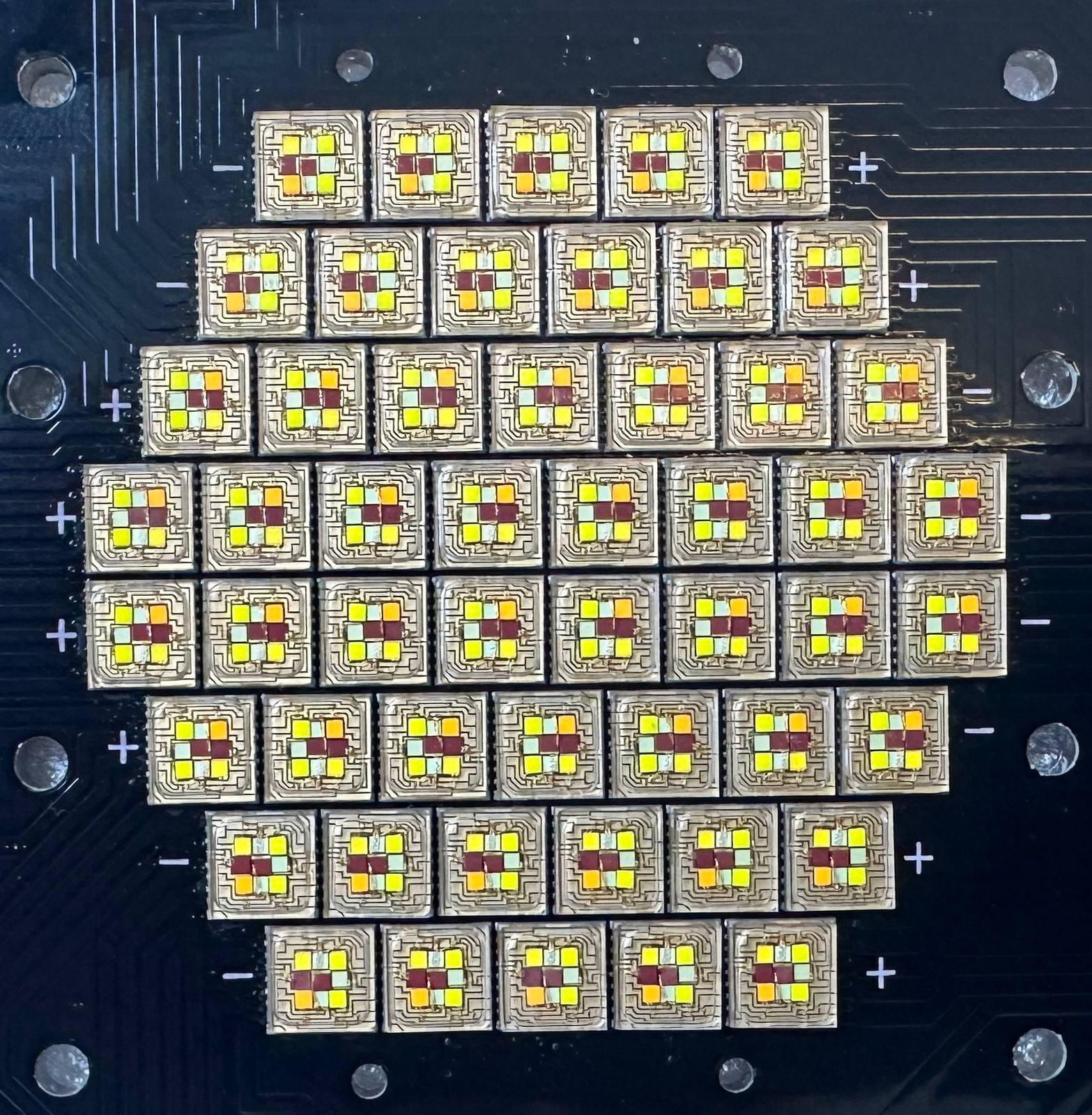
The 6-channel spectral LED engine for film, broadcast, and stage lighting.
Traditional RGBW covers only ~65% of the CIE 1931 gamut. The critical yellow-green region (540-580nm) — where human vision peaks — remains poorly represented, causing visible color inaccuracies in warm white tones.
4-channel mixing produces metameric matches that look acceptable to the eye but fail on digital sensors. ARRI, RED, and Sony Venice cameras expose color mismatches invisible to the naked eye.
RGBLAC extends the controllable gamut by ~1.4x vs RGBW. Lime (565nm) and Amber (595nm) channels fill the critical warm-white gap, while Cyan (498nm) perfects cool-white reproduction.
6 independent channels enable spectral tuning per camera sensor response. Achieve TLCI > 95 and SSI > 90 simultaneously — a feat impossible with 4-channel architectures.
The 6-channel RGBLAC engine spans 400–700 nm with zero spectral gaps. Lime fills the critical green-yellow valley; Amber anchors warm skin tones; Cyan bridges blue-green.
Each channel serves a specific role in the spectral reconstruction chain. Understanding their purpose reveals why 6 channels outperform 4.
Foundation of warm color rendering. Critical anchor for skin tones, reds, and the entire warm-white CCT range from 1800K–3200K.
The gamut extender. Fills the critical yellow-green gap where human vision peaks. Single most impactful addition for CRI and TLCI improvement.
Primary luminance channel. Dominates the luminous flux output at ~70% of perceived brightness. Essential for daylight simulation.
The warm transition bridge. Smoothes the Red-Green boundary for superior 2700K–4000K reproduction. Eliminates pink/magenta cast in skin tones.
Cool-white anchor. Powers CCT ranges above 6500K. With Cyan support, enables precise Ge-Mg shift control for broadcast compliance.
The cool precision tool. Bridges Blue-Green gap for accurate 7000K–20000K reproduction. Essential for daylight-balanced broadcast and HMI emulation.
Extending the spectral boundaries at both ends of the visible spectrum, this 8-channel architecture goes beyond the core RGBLAC engine. Deep Red 660nm anchors the long-wavelength frontier — dramatically boosting R9 saturation, enriching skin-tone fidelity, and delivering the visceral warmth that standard RGB solutions inherently miss. At the violet-blue end, 450 nm (UV-cut) completes RGBLAC's 430–470 nm continuum — markedly boosting the saturation of sapphire, indigo and night-sky tones while lifting SSI (D56). Its UV-cut package strips sub-400 nm radiation to protect cast and crew, the same safety-first approach NANLUX adopted in its Nebula C8, the industry's first 8-color engine (used in the Evoke 600C / 150C). Together, this platform pushes color gamut well beyond Rec. 2020 coverage, delivering true full-spectrum white, hyper-saturated theatrical color, and human-centric circadian tuning — all from a single compact LED array.
1.4× wider gamut than RGBW. Covers DCI-P3 and Rec.2020 with superior metameric control. CRI > 95 across entire 1800K–20000K CCT range — no falloff at extremes.
Factory-calibrated per-LED spectral LUT. 6-channel DMX/RDM with Ge-Mg shift compensation. CAM16 perceptual uniform space for smooth CCT transitions.
Linear Optimization over 6 degrees of freedom. Simultaneously optimizes color accuracy, max brightness, and CRI. Supports spectral tuning per camera sensor (ARRI/RED/Sony).
Netflix-approved cinema lighting. Broadcast-compliant Ge-Mg control. Stage-ready with professional console integration. 500W+ high-power module leadership.
IESNA LM-80-20 compliant. Lumen maintenance > 90% at 60,000 hours. Tested per IES standards.
Full CCT range 1800K–20000K. Ra > 95, R9 > 90. No falloff at warm or cool extremes.
EBU Tech 3355 compliant. Netflix-approved spectral quality. SSI > 90 for cinema sensors.
Dive deeper into RGBLAC spectral science, or explore the RGBLAC-enabled products and related TYANSHINE LED platforms.
The six-channel architecture and the Lime, Amber, Cyan channels explained.
Read → FILM LIGHTINGTungsten emulation, skin tone and LED volumes compared on camera.
Read → COLORHow channel count changes gamut, white quality and camera behavior.
Read →We typically reply within 1 hour on business days. Pick your channel:
WhatsApp Business erick@txled.com +86 18823315671 Send inquiry form